
A. Basic Program Information
- Official name of the academic program
- Bachelor of Industrial Technology
- Degree/Qualification
- Electrical Technology
- Program Level
- Level II
- College/academic unit offering the program
- College of Industrial Technology/Electrical Technology Department
- Campus where the program is offered
- Estancia and Sara
- Program Duration
- 4 years
- Mode of Delivery
- Face to Face
- Language(s) of instruction
- English, Tagalog, and Hiligaynon
- Brief program description
B. Program Objectives and Outcomes
- Develop competency based skills techniques.
- Provide actual updated and relevance experience to student through OJT programs.
- Prepare students to become effective and efficient leader and entrepreneurs.
- Undertake extension and research program in line in Electrical Technology to develop knowledge and skills of the students.
- Inculcate desirable values and work as crucial factors in national development.
- To instill the values of responsiblity, integrirty, cooperation and hardwork among graduates.
- Ability to analyze broadly-defined industrial technology processes by using analytical tools that enhance creativity, innovativeness, and intellectual curiosity to improve methods, processes, and systems that meet the industry standards.
- Ability to implement broadly-defined industrial systems, components, products, or processes to meet specific industry needs with proficiency and flexibility in the area of specialization in accordance with global standards.
- Ability to apply appropriate techniques, resources, and state-ofthe-art industrial technology tools to meet current industry needs and use these modern tools and processes to improve and increase entrepreneurial activities upholding the safety and health standards of business and industry.
- Ability to communicate with diverse groups of clienteles the appropriate cultural language with clarity and persuasion, in both oral and written forms, including understanding and giving of clear instructions, high comprehension level, effectiveness in delivering presentations and writing documents, and articulating technological innovation outputs.
- Ability to develop leadership and management skills in a teambased environment by making informed decisions, keeping the team motivated, acting & delegating responsibility, and inspiring positive changes in the organization by exercising responsibility with integrity and accountability in the practice of one's profession.
- Practice the moral responsibilities of an industrial technologist to manage and balance wider public interest and uphold the norms and safety standards of the industrial technology profession.
- Ability to demonstrate enthusiasm and passion for continuous personal and professional development in broadly-defined industrial technology and effecting positive changes in the entrepreneurial and industrial endeavor.
- Recognition of the need for, and an ability to engage in lifelong learning.
- Technicians/Skilled Worker
- Can perform tasks independently without supervision, and
- Has the mastery of performance standards that are required in the Technician Competency Skills Assessment.
- Industry supervisors and managers
- Can perform management functions in industrial organizations; and
- Can contribute to the Total Quality Management (TQM) at industrial organizations
- Industry consultant and technologist
- Can conduct technological innovations to solve problems in industry; and
- Can perform higher skills required by industries
- Technology developer and innovator
- Can create innovative and market-driven products; and
- Can develop highly-marketable technologies.
C. Curriculum
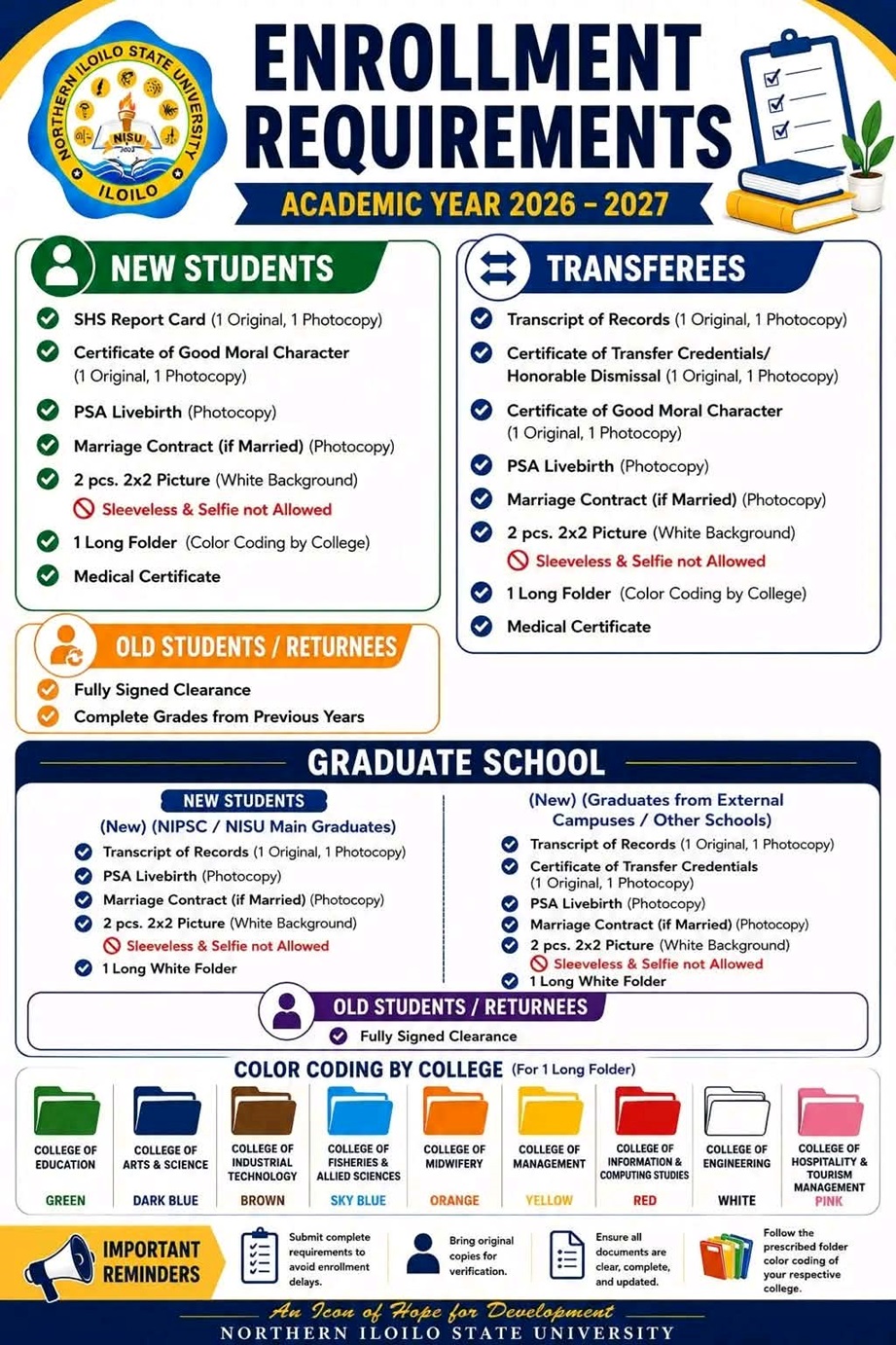
D. Admission Information
E. Fees, Scholarships, and Financial Assistance
- RA No. 10931 (Free Tuition Law)
- Tertiary Education Subsidy (TES)
- Tulong Dunong Program (TDP)
F. Faculty Profile
| Name of Faculty (List all the core faculty in your program) | Qualifications | (Content/Pof.Ed/GenEd) Specialization 1 | (Content/Pof.Ed/GenEd) Specialization 2 | (Content/Pof.Ed/GenEd) Specialization 3 | ||
| Bachelor’s Degree | Master's Degree | Doctorate Degree | ||||
| Dr. Rafael B. Berte | BS Industrial Education major in Electrical Technology | Master of Arts in Industrial Education major in Industrial Arts | Doctor of Education major in Industrial Education Management | Electrical Technology | Industrial Arts | Industrial Education Management |
| Dr. Arthur E. Gelloagan | BS Industrial Education major in Electrical Technology | Master of Education major in Educational Management
Master in Industrial Management | Doctor of Education in Curriculum and Instruction | Electrical Technology | Educational Management
Industrial Management | Curriculum and Instruction |
| Dr. Myra C. Vasquez | BS Industrial Education major in Electrical Technology | Master of Education major in Educational Management | Doctor of Education in Curriculum and Instruction | Educational Management | Educational Management | Curriculum and Instruction |
| Engr. Ronald D. Derla | BS Electrical Engineering
BS Computer Engineering | Master of Engineering | Doctor of Industrial Technology (CAR) | Electrical Engineering
Computer Engineering | Engineering | Industrial Technology |
| Mr. Rene G. Gariando | BS Industrial Technology major in Electrical technology | Master of Public Administration |
| Electrical technology | Public Administration |
|
| Mr. Carlo B. Nalica (COS) | BS Industrial Technology major in Electrical technology | Master of Industrial Technology (On-going)
|
| Electrical technology | Industrial Technology |
|
G. Research and Innovation
Patent Application – Dr. Rafael B. Berte
- A Door Shutter Security System Mechanism
- Monitoring Device for Aquaponics System
- A Motorized Elbow Forming Mechanism for Electrical Conduits with Interchangeable Forming Members
- A Portable Angle-Guiding Apparatus for Cutting Electrical Raceway
- An Electrical Conduit Forming Mechanism
- Portable Apparatus for Shaping and Joining Polyvinyl Chloride for Electrical Installation
- Rechargeable Electric Wire Rewinding Machine with Automatic Tension and Layering Control
- Universal Multipurpose Electric Motor Component Extraction Mechanism
- A Portable Retaining Tool for Installation of Flush-Mounted Electrical Fixtures
- A Mechanism for Attaching and Detaching Fluorescent Tube
H. Industry and Community Engagement
- EPA EJA ENERGETIC CONSTRUCTION CORPORATION
- WARLEN INDUSTRIAL SALES CORPORATION
- DPD ELECTRICAL INSTALLATION SERVICE
- LBCARMELO ENGINEERING
- Ralenns Electrical Supply & Services
- LGU, Estancia
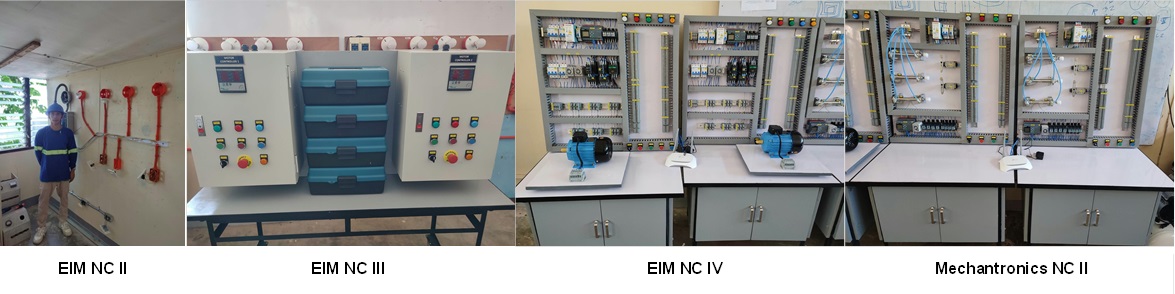
I. Facilities and Learning Resources
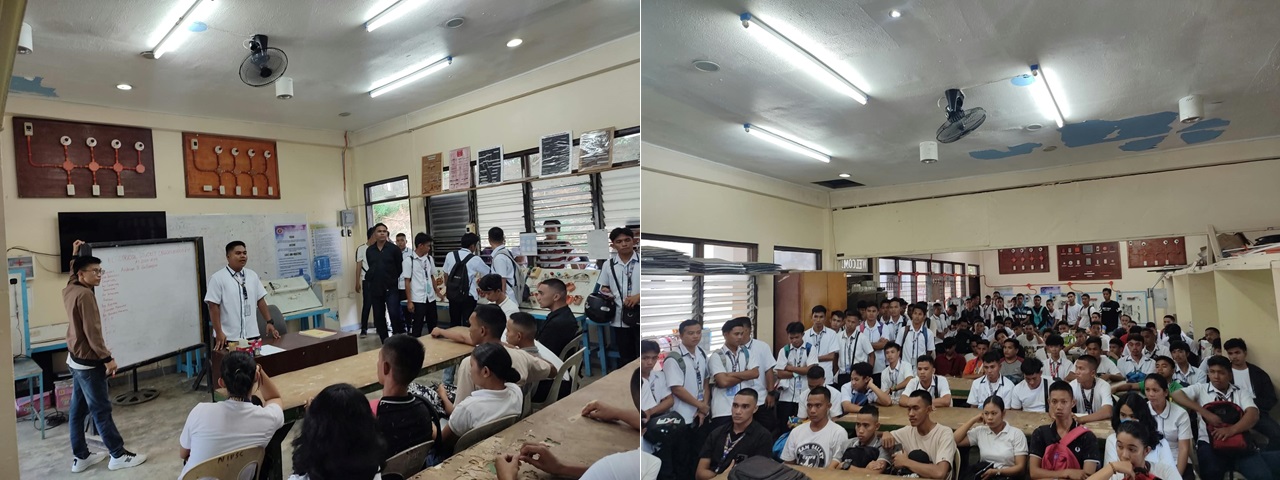
J. Student Development and Activities
- Electrical Students Organization (ESO)
K. Accreditation, Recognition, and Professional Outcomes
- COPC No. 002, Series of 2017 BOT Resolution No. 67-15S-2003
- AACCUP Level II
L. Career and Graduate opportunities
- Graduates of the Bachelor of Industrial Technology Program are the technologist who are:
- Technicians/Skilled Worker
- Industry supervisors and managers
- Industry consultant and technologist
- Technology developer and innovator
M. Program Highlight and Achievements
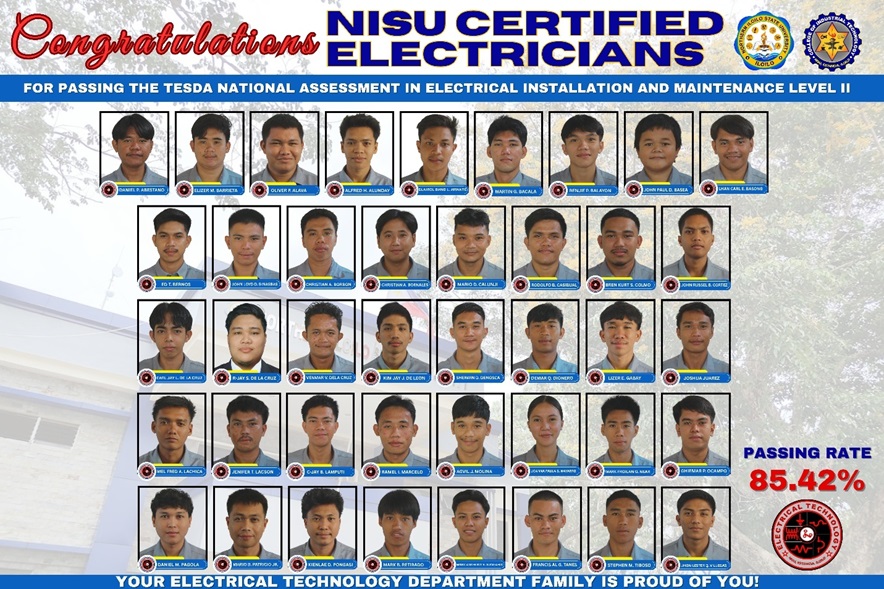
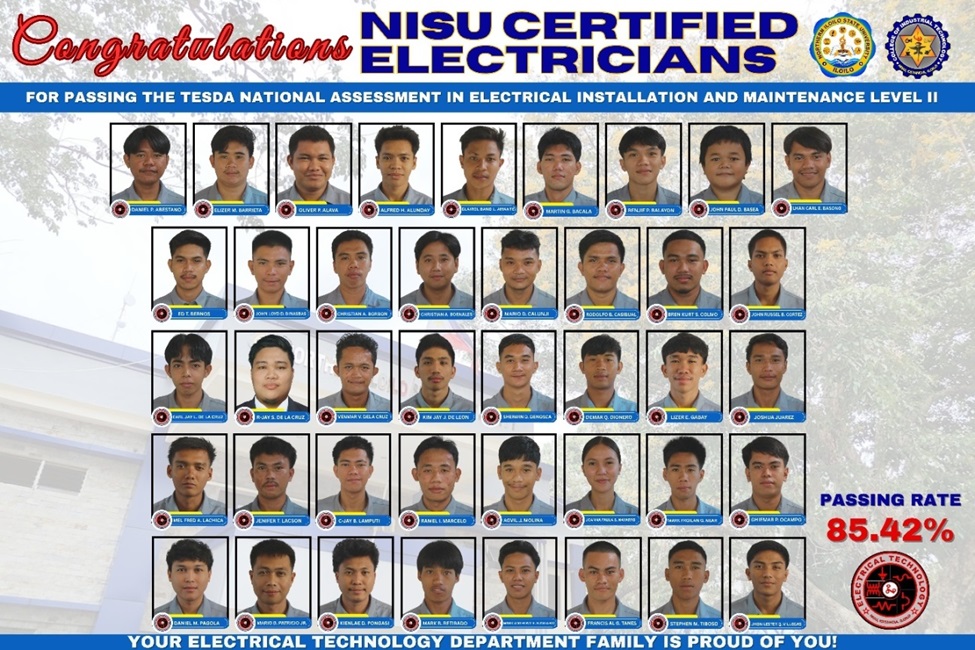
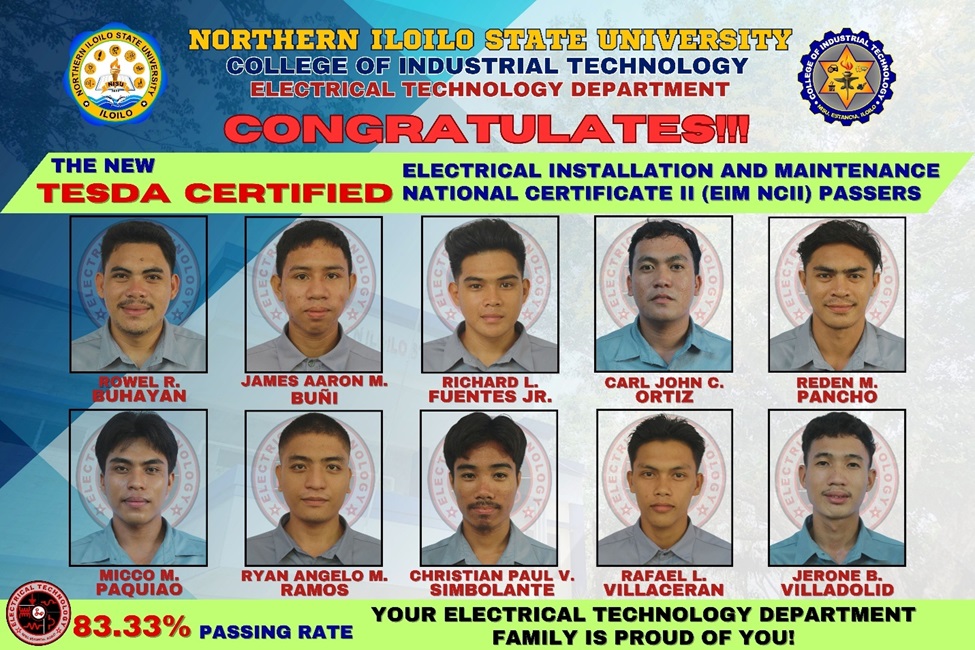
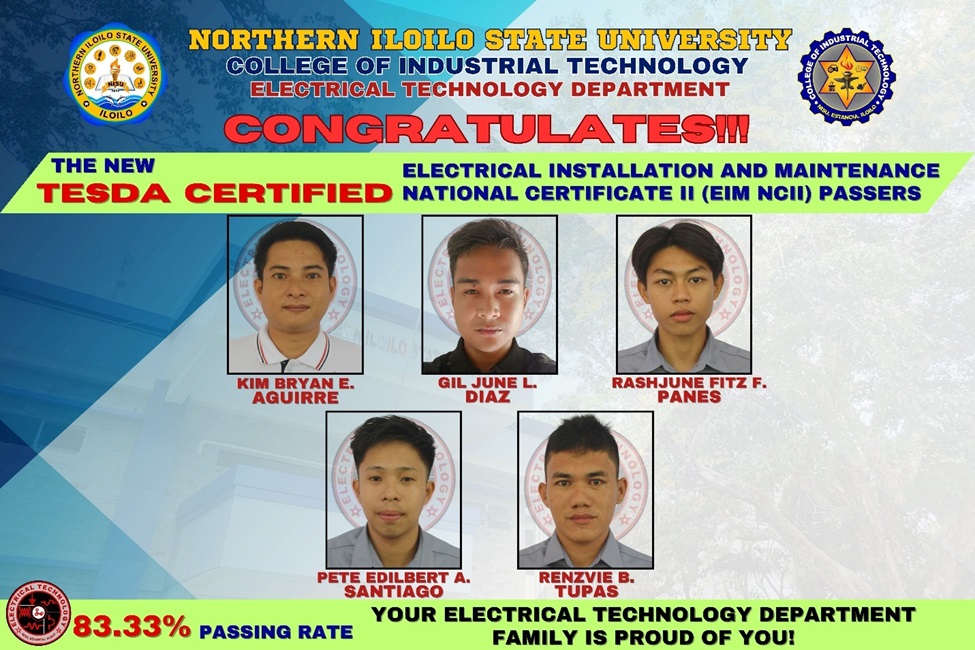
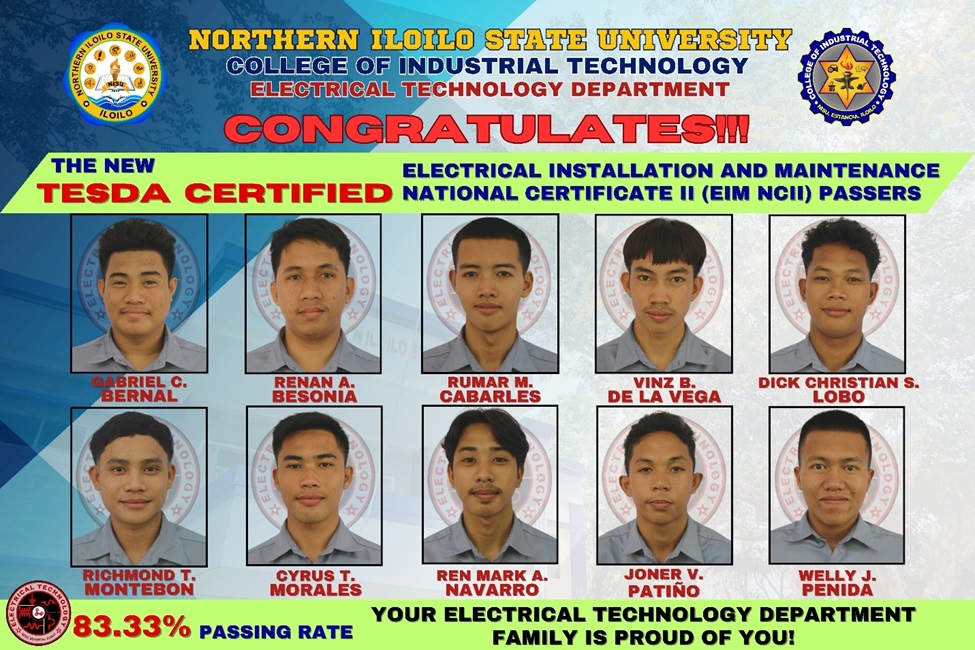
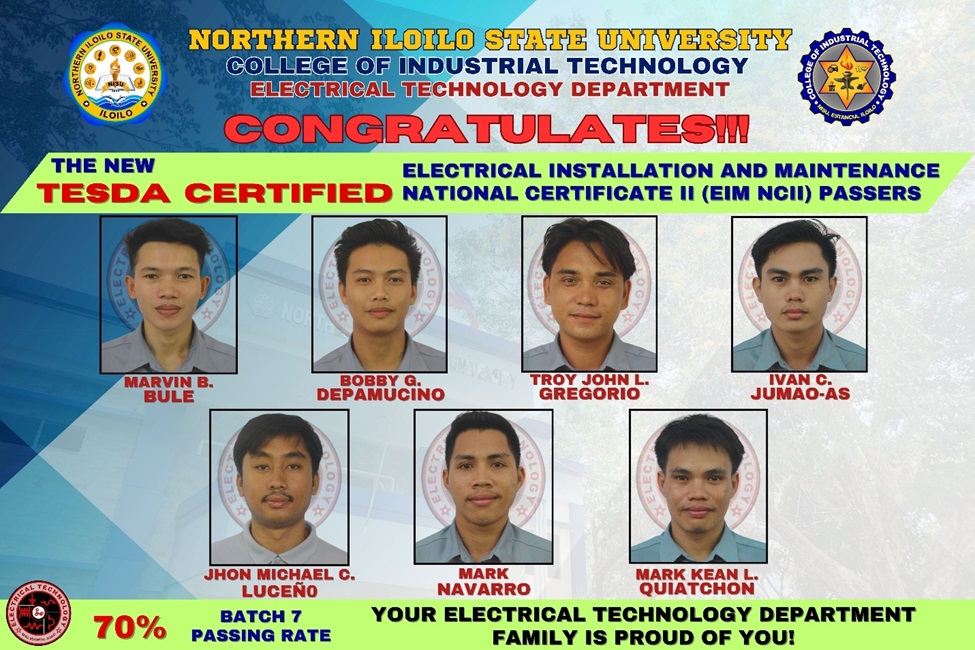
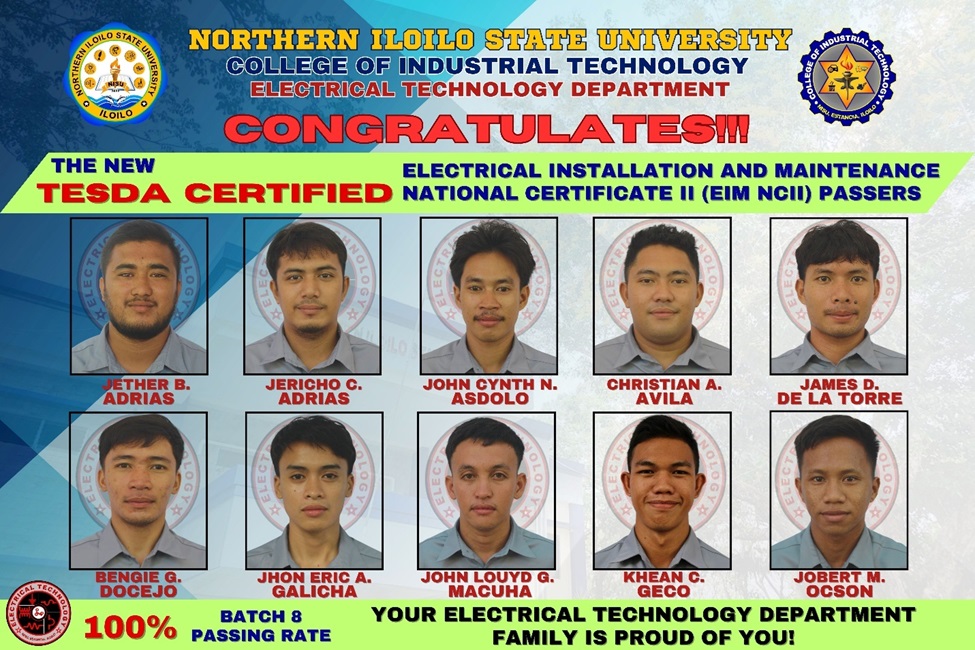
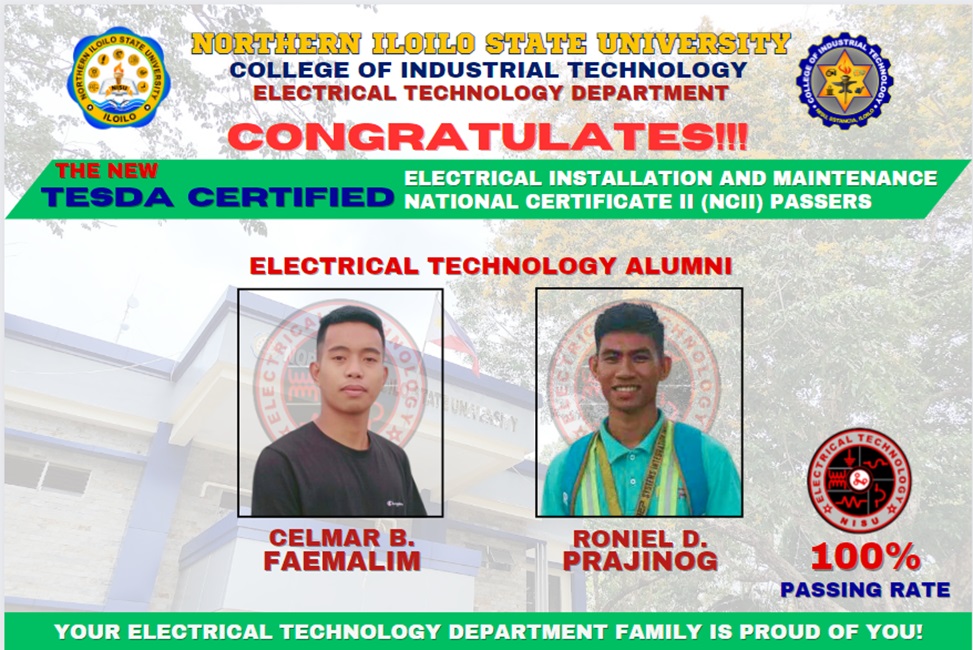
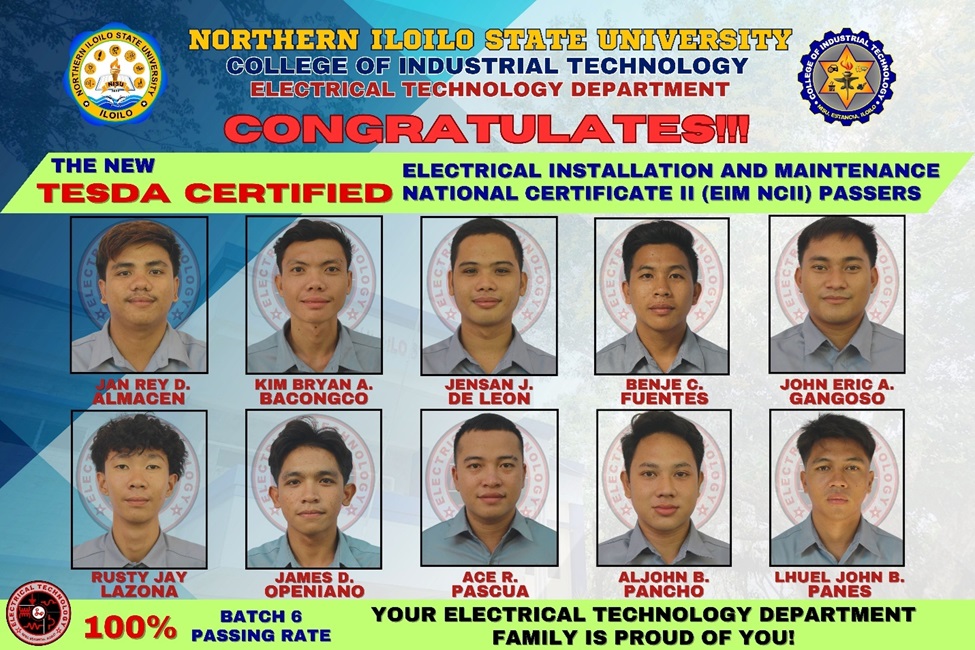
National Certification Passers in Electrical Installation and Maintenance
 | |
 |  |
 |  |
 |  |
 |  |
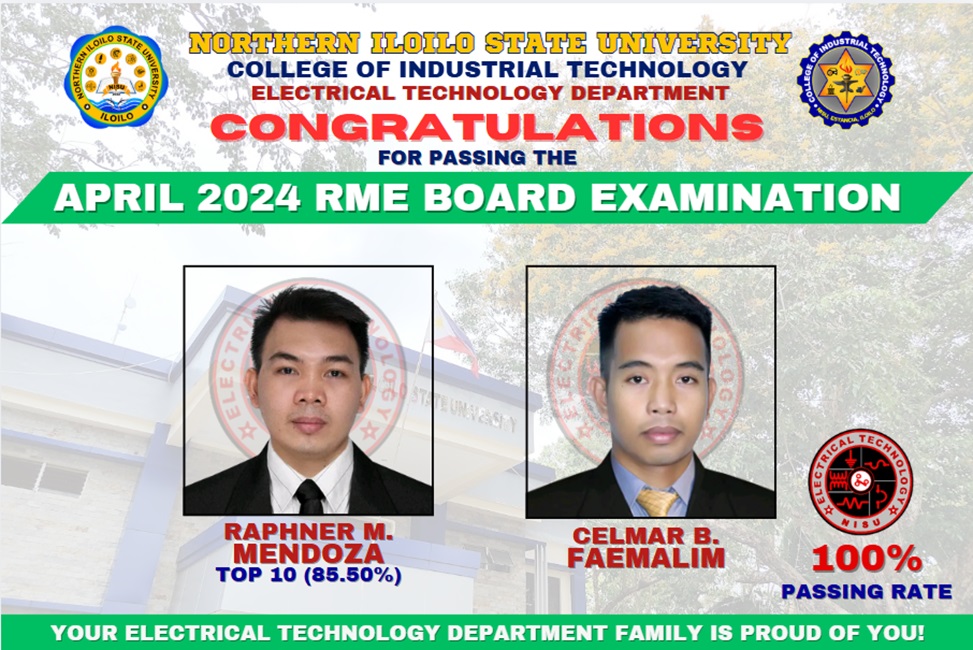
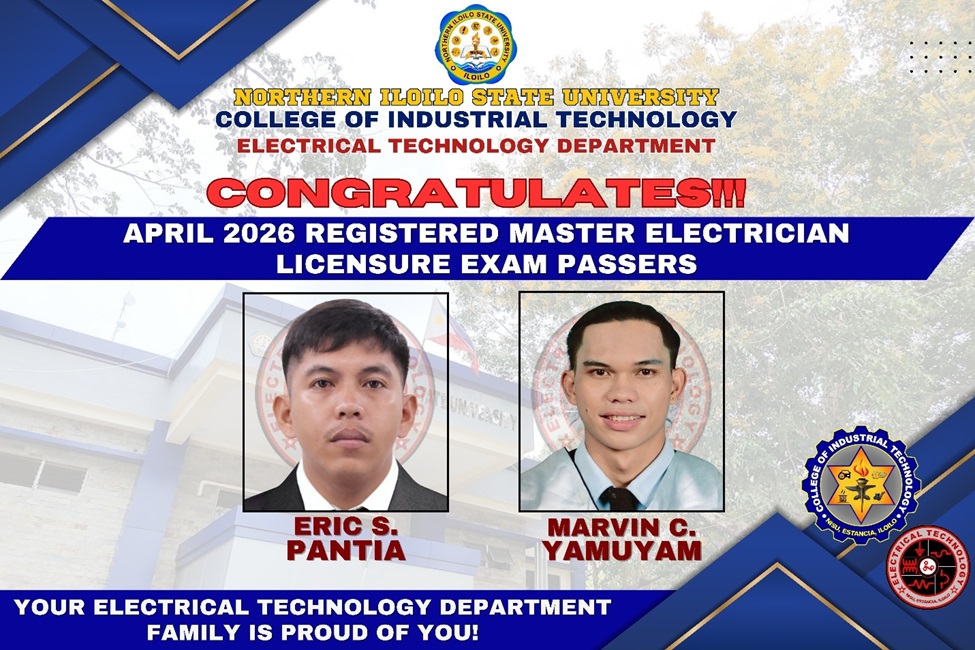
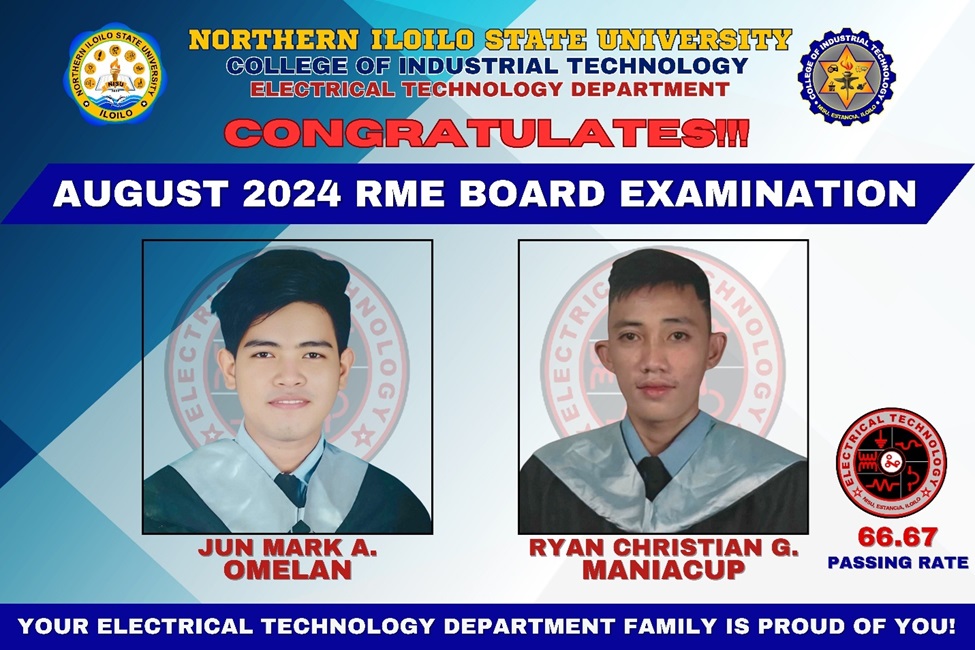
Registered Master Electrician Passers
| |  |
 |  |
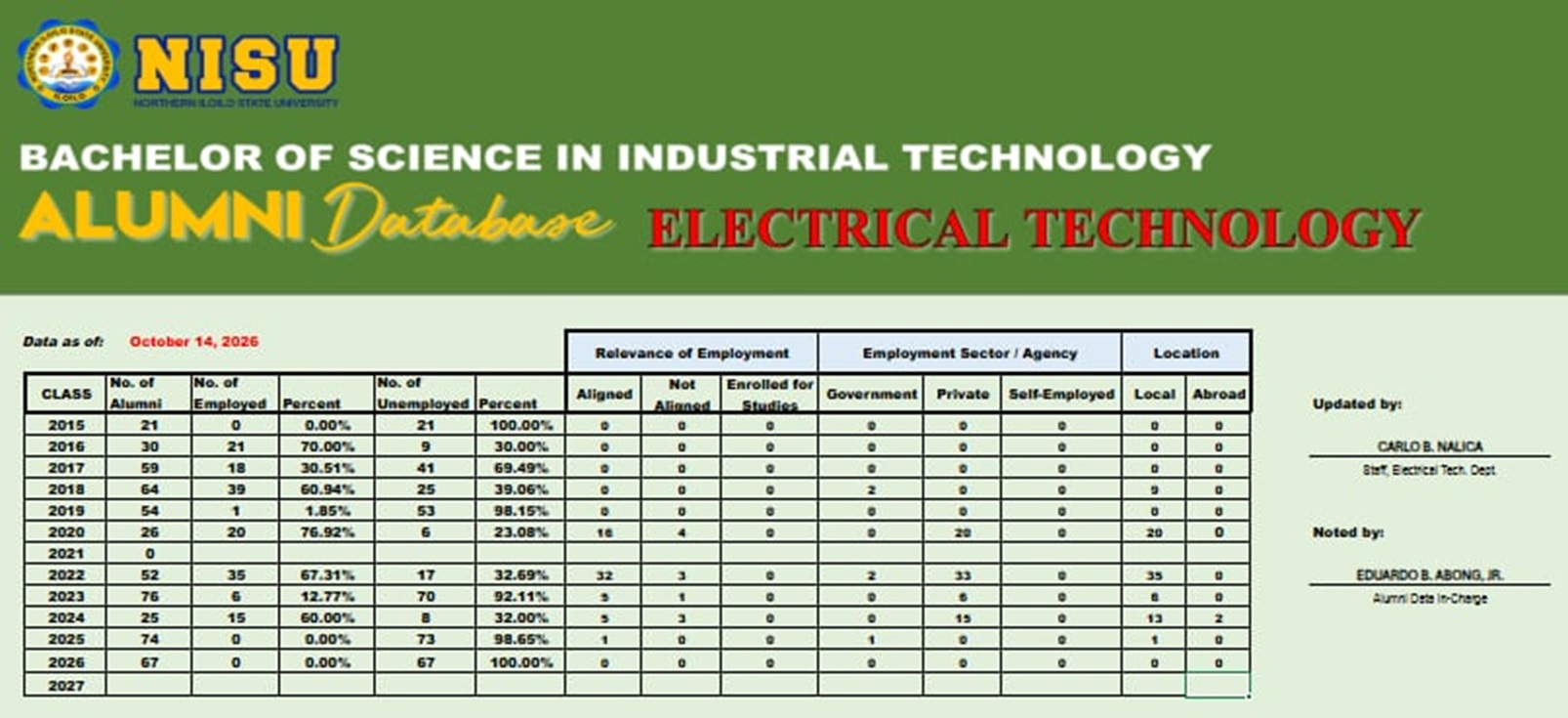
N. Program Statistics
Enrollment Trend
| Academic Year | First Year | Second Year | Third Year | Fourth Year | Total Enrollment | % Increase/Decrease |
| 2021-2022 | 235 | 70 | 164 | 132 | 601 | 65.39% |
| 2022–2023 | 169 | 178 | 57 | 155 | 559 | 91.01% |
| 2023–2024 | 236 | 139 | 163 | 51 | 592 | 94.43% |
| 2024–2025 | 237 | 206 | 131 | 154 | 728 | 81.32% |
| 2025–2026 | 246 | 194 | 197 | 131 | 768 | 94.79% |
Analysis: The enrolment data show an overall positive trend from AY 2021–2022 to AY 2025–2026. Total enrolment increased from 601 students in AY 2021–2022 to 768 students in AY 2025–2026, representing an overall increase of 167 students or approximately 27.79%. This indicates sustained student interest and continued growth of the program.
Although total enrolment declined slightly to 559 students in AY 2022–2023, the program recovered in the succeeding years, reaching 592 students in AY 2023–2024 and 728 students in AY 2024–2025. The highest enrolment was recorded in AY 2025–2026 with 768 students. The increasing number of students, particularly in the first-, second-, and third-year levels during the latter years, suggests improved student retention and progression.
Overall, the enrolment trend reflects the program's growing capacity to attract and retain students. Continued enhancement of faculty resources, laboratory facilities, instructional equipment, and student support services is recommended to sustain enrolment growth while maintaining the quality of instruction.
Retention Rate
| Academic Year | Previous Enrollment | Continuing Students | Retention Rate (%) |
| 2021-2022 | 245 | 201 | 82.04% |
| 2022–2023 | 292 | 267 | 91.44% |
| 2023–2024 | 306 | 283 | 92.48% |
| 2024–2025 | 367 | 361 | 98.37% |
| 2025–2026 | 391 | 377 | 96.42% |
Analysis: The retention rate data for the Bachelor of Science in Industrial Technology major in Electrical Technology show a consistently strong student retention performance from AY 2021–2022 to AY 2025–2026. The retention rate increased from 82.04% in AY 2021–2022 to 96.42% in AY 2025–2026, indicating that a greater proportion of students continued their studies in the program.
The retention rate improved steadily from 82.04% in AY 2021–2022 to 91.44% in AY 2022–2023, 92.48% in AY 2023–2024, and reached its highest rate of 98.37% in AY 2024–2025. Although the retention rate slightly decreased to 96.42% in AY 2025–2026, it remained very high, with 377 out of 391 students continuing in the program.
Overall, the data indicate effective student retention within the program. The high retention rates may be attributed to improved academic support, faculty mentoring, student advising, and the continued relevance of the Bachelor of Science in Industrial Technology major in Electrical Technology program. Continued implementation of student support and retention initiatives is recommended to sustain and further improve this performance.
Completion Rate
| Entry Cohort (Year Admitted as First Year) | Expected Year of Completion | Original Cohort Size | Students Completing Academic Requirements | Students Who Did Not Complete | Completion Rate (%) |
| 2018 | 2022 | 98 | 52 | 46 | 53.06% |
| 2019 | 2023 | 101 | 76 | 25 | 75.25% |
| 2020 | 2024 | 82 | 25 | 57 | 30.49% |
| 2021 | 2025 | 125 | 74 | 51 | 59.20% |
| 2022 | 2026 | 89 | 67 | 22 | 75.28% |
| 2023 | 2027 | 122 | N/A | N/A | N/A |
Analysis: The completion rate data for the Bachelor of Science in Industrial Technology major in Electrical Technology show varying levels of student completion among the entry cohorts from 2018 to 2022. The highest completion rate was recorded for the 2022 entry cohort, with 67 out of 89 students completing the academic requirements by 2026, equivalent to 75.28%. This was closely followed by the 2019 entry cohort, which achieved a completion rate of 75.25%, with 76 out of 101 students completing the program requirements.
The 2018 entry cohort recorded a completion rate of 53.06%, with 52 out of 98 students completing the academic requirements. The 2021 entry cohort showed a completion rate of 59.20%, with 74 out of 125 students completing the program. Meanwhile, the 2020 entry cohort had the lowest completion rate at 30.49%, with only 25 out of 82 students completing the academic requirements. This lower rate may be associated with academic, personal, financial, or other challenges that affected students during their period of study.
The 2023 entry cohort is expected to complete the program in 2027; therefore, completion data are not yet available. Overall, the data show that while completion rates have improved for the more recent cohorts, the program should continue strengthening academic advising, student monitoring, remediation, financial support referrals, and retention interventions to help more students complete their academic requirements within the expected program duration.
Graduation Rate
Formula: Graduation Rate = (Number of Graduates ÷ Original Cohort) × 100
| Academic Year | Original Cohort | Number of Graduates | Graduation Rate (%) |
| 2022 | 98 | 52 | 53.06% |
| 2023 | 101 | 76 | 75.25% |
| 2024 | 82 | 25 | 30.49% |
| 2025 | 125 | 74 | 59.20% |
| 2026 | 89 | 67 | 75.28% |
Analysis: The graduation rate data show fluctuating graduate output from 2022 to 2026. The graduation rate ranged from 30.49% to 75.28%, with the highest rate recorded in 2026, when 67 out of 89 students graduated. A similarly high graduation rate of 75.25% was achieved in 2023.
Although the graduation rate declined to 30.49% in 2024, it improved in the succeeding years, increasing to 59.20% in 2025 and 75.28% in 2026. This indicates a positive recovery in the program’s ability to produce graduates.
Overall, the data suggest an improving trend in graduation rates in recent years. Continued implementation of academic advising, student monitoring, and retention strategies will help sustain this positive performance and support more students in completing the program on time.
Attrition Rate
Formula: Attrition Rate = (Students Who Left the Program ÷ Original Enrollment) × 100
| Academic Year | Original Enrollment | Students Who Left/Transferred/Dropped | Attrition Rate (%) |
| 2021-2022 | 601 | 13 | 2.16% |
| 2022–2023 | 559 | 23 | 4.11% |
| 2023–2024 | 592 | 23 | 3.89% |
| 2024–2025 | 728 | 7 | 0.96% |
| 2025–2026 | 768 | 14 | 1.82% |
Analysis: The attrition rate data show consistently low student attrition from AY 2021–2022 to AY 2025–2026. The attrition rate ranged from 0.96% to 4.11%, indicating that the majority of students remained enrolled and continued their studies in the program.
The highest attrition rate was recorded in AY 2022–2023 at 4.11%, while the lowest was recorded in AY 2024–2025 at 0.96%. Although the attrition rate slightly increased to 1.82% in AY 2025–2026, it remained relatively low, reflecting the program's effectiveness in retaining students.
Overall, the data indicate a favorable attrition trend and demonstrate the effectiveness of the program’s student retention initiatives. Continued implementation of academic advising, mentoring, and student support services is recommended to maintain low attrition rates and promote student success
Summary of Key Performance Indicators
| 2022 | 2023 | 2024 | 2025 | 2026 | Five-Year Average | |
| Total Enrollment (%) | 65.39% | 91.01% | 94.43% | 81.32% | 94.79% | 84.99% |
| Retention Rate (%) | 82.04% | 91.44% | 92.48% | 98.37% | 96.42% | 92.15% |
| Completion Rate (%) | 53.06% | 75.25% | 30.49% | 59.20% | 75.28% | 58.66% |
| Graduation Rate (%) | 53.06% | 75.25% | 30.49% | 59.20% | 75.28% | 58.66% |
| Attrition Rate (%) | 2.16% | 4.11% | 3.89% | 0.96% | 1.82% | 5.02% |
O. Contact Information
- Name and Designation of the Program Chair/Coordinator
- Rafael B. Berte, EdD / Chairperson, Electrical Technology Department
- College/Academic Unit
- College of Industrial Technology/Electrical Technology Department
- Campus
- Estancia
- Official NISU email address
This email address is being protected from spambots. You need JavaScript enabled to view it.
- Official contact number
- 09382559090
- Office location
- Electrical Technology Building